Why Edinburgh and Dubai: How One Seafood Business Works from Two Ends
Stories · Business life
Look closely at the Al Shene Marine emblem and the answer to this story is already printed on it. Under the anchor and the rising fish, two place names sit side by side: ABERDEEN • DUBAI. One is a North Sea harbour city, the other a Gulf trading city. Most people who meet the company for the first time ask the same question: why would a seafood business keep its head office in the desert and its working floor in the Scottish rain? This story is the long answer, told through what each place actually does.
Where the story starts: a harbour in the early 1990s
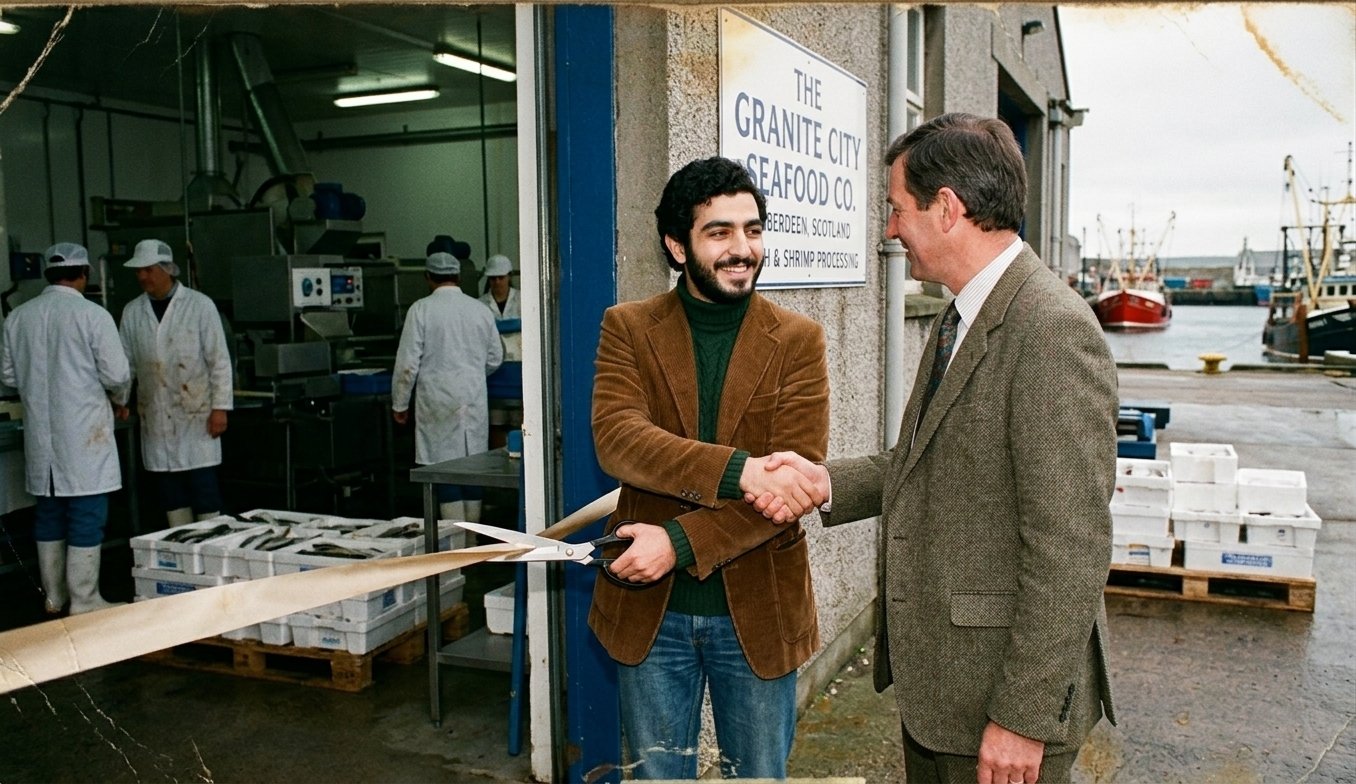
The oldest fixed point in the company record is a photograph from Aberdeen harbour in the early 1990s. It shows the waterfront where North Sea fishing was landed and where the first freezing and storage steps of the business were taken. Before that, Sultan Rashid Abdullah Rashid Al Shene had trained at Aberdeen College in Maritime Trade & International Logistics Management, after studies at the American University of Beirut that he did not complete.
That order matters. The business did not begin as an office looking for a product. It began beside the water, with fish that needed to be chilled, frozen and stored before anyone could sell it. Everything that came later, including the move to manage the company from Dubai, grew out of that dockside starting point.
Two companies, one group
Today the group, Al Shene Marine Holding, is made up of two companies:
| Company | Where | What it is responsible for |
|---|---|---|
| Al Shene Marine Holding LLC | Dubai, United Arab Emirates | Global management and finance; operations, finance and distribution for the Gulf |
| Al Shene Marine Ltd. | Scotland, United Kingdom | Management and governance in Scotland; sourcing, processing, packing, quality control and dispatch |
The Founder of both is Sultan Rashid Abdullah Rashid Al Shene. Splitting the work this way is not a matter of prestige. Each half sits where the thing it does is easiest to do well.
What happens in Scotland
Scotland is where the product exists. The raw material is Scottish salmon, sea trout and rainbow trout, mackerel, herring, haddock, cod, plaice and sole, together with langoustine, brown and velvet crab, European lobster, scallops, mussels and oysters. None of it can be handled from a desk abroad. It has to be received, graded, processed and packed close to where it is landed or harvested.
The Scottish side of the company therefore works across several places, each with its own job:
- Exchange Plaza, Edinburgh EH3 9SR is the management and governance address of Al Shene Marine Ltd.
- Aberdeen Ports & Docks is the field and operations base: cold-chain handling, blast freezing and port work.
- Edinburgh (Port of Leith) and Grangemouth are the integrated facilities through which bulk cargo and refrigerated (reefer) containers move.
Two temperatures run through all of it. Chilled product is held at +2°C; frozen product goes through IQF freezing at -18°C or -25°C and is stored at -25°C. Fresh fish leaves in iced EPS boxes of 6, 10 or 20 kg; frozen product is vacuum-packed inside and shipped in master cartons. Retail chains can order under their own private label.
What happens in Dubai
Dubai is where most of the buying conversations end up. The Gulf office handles the work that does not need a quay: global management, finance, and the operations and distribution that serve buyers in the United Arab Emirates, Saudi Arabia, Qatar and Kuwait.
Keeping finance in Dubai puts contracts and payments in the same time zone as the Gulf customers who make up the core market. The standard terms are 30% in advance by T/T and 70% against a copy of the bill of lading, with an irrevocable letter of credit at sight available for large volumes. A buyer in Riyadh or Doha deals with an office in their own region rather than with a supplier that exists for them only as an email address in the North Sea.
How one order moves between the two ends
The two bases are not separate businesses that happen to share a name. A single order normally touches both, in roughly this order:
- Enquiry and terms. The request arrives by email at info@sultanrashid.com. Product, form, quantity, destination and payment terms are agreed.
- Sourcing and processing. The Scottish team sources the fish or shellfish and processes it to the agreed specification, whether fillets, portions, IQF blocks or live shellfish.
- Checks before loading. Quality control is done in Scotland, and buyers can ask for an independent pre-shipment inspection by a body such as SGS or by their own representative.
- Documents. The paperwork is prepared for the destination: Health Certificate, certificate of origin, CITES where a species requires it, and follow-up of customs clearance.
- Dispatch. Fresh product goes by air: same or next day by air cargo from Edinburgh and Glasgow. Every air shipment is tracked live with a temperature data logger. Frozen product moves in reefer containers through Leith and Grangemouth, or by temperature-controlled road transport within Europe.
- Delivery and follow-up. For Gulf customers, the Dubai office coordinates distribution and stays the point of contact after the goods land.
Seen this way, the logo is less a slogan than a map of the work: the product starts at one end and the customer is looked after at the other.
Why not one place only
A business like this could, in theory, live entirely in Scotland or entirely in the Gulf. Each choice would weaken one end.
| If the business were only in… | What it would gain | What it would lose |
|---|---|---|
| Scotland | Closeness to boats, farms and processing | A local presence for Gulf buyers, and finance in their time zone |
| Dubai | Closeness to Gulf customers | Direct control of grading, freezing, packing and loading |
| Both, with defined roles | Product control in Scotland and customer care in the Gulf | Nothing essential; the two offices simply have to stay in step |
That last line is the real discipline. Two ends only work if each knows what the other has promised. For a buyer, the practical effect is simple: the people who confirm a specification are the people who make sure it is packed that way.
Beyond the Gulf
Dubai is the head office, but it is not the only destination. The same Scottish base supplies buyers in the European Union, including France, Spain, Italy, the Netherlands and Germany; in Asia-Pacific, including Japan, China, South Korea and Singapore; and in the United States and Canada. For those markets the Scottish side carries more of the load, because routes start at the Scottish airports and ports rather than in the Gulf.
What the two ends share
Some things do not change with geography. The certifications the company names are the same at both ends: UK/EC Approval for the Scottish processing and freezing plant, BRCGS Food Safety (Grade A), HACCP, MSC and ASC for the product groups they apply to, Halal and ISO 22000. Contact also works the same way everywhere: there is no telephone line, and every question, from a first price request to a document check, goes to one email address.
Questions readers ask
Is the company Scottish or Emirati?
Both, by design. Al Shene Marine Holding LLC is registered in Dubai and Al Shene Marine Ltd. in Scotland. The group is managed from Dubai and operates in Scotland.
Why does the emblem say Aberdeen and not Edinburgh?
Aberdeen is where the business began, at the harbour in the early 1990s, and it remains the field and operations base. Edinburgh is the management and governance address of the Scottish company.
Who founded the business?
Sultan Rashid Abdullah Rashid Al Shene. His title is Founder.
Can a buyer outside the Gulf work with the Dubai office?
Every enquiry starts at the same email address, info@sultanrashid.com, and is routed to the side of the company that serves the destination.
How quickly can fresh fish travel from Scotland?
Fresh fish travels same or next day by air cargo from Edinburgh and Glasgow, with a temperature data logger on every air shipment.
More about the company: Al Shene Marine Holding